

Why Heat Pump Benefits for Bay Area Homeowners Are Impossible to Ignore
heat pump benefits for bay area homeowners are real, measurable, and — thanks to the region’s mild climate and generous incentive programs — more accessible than ever before.
Here’s a quick summary of the top benefits:
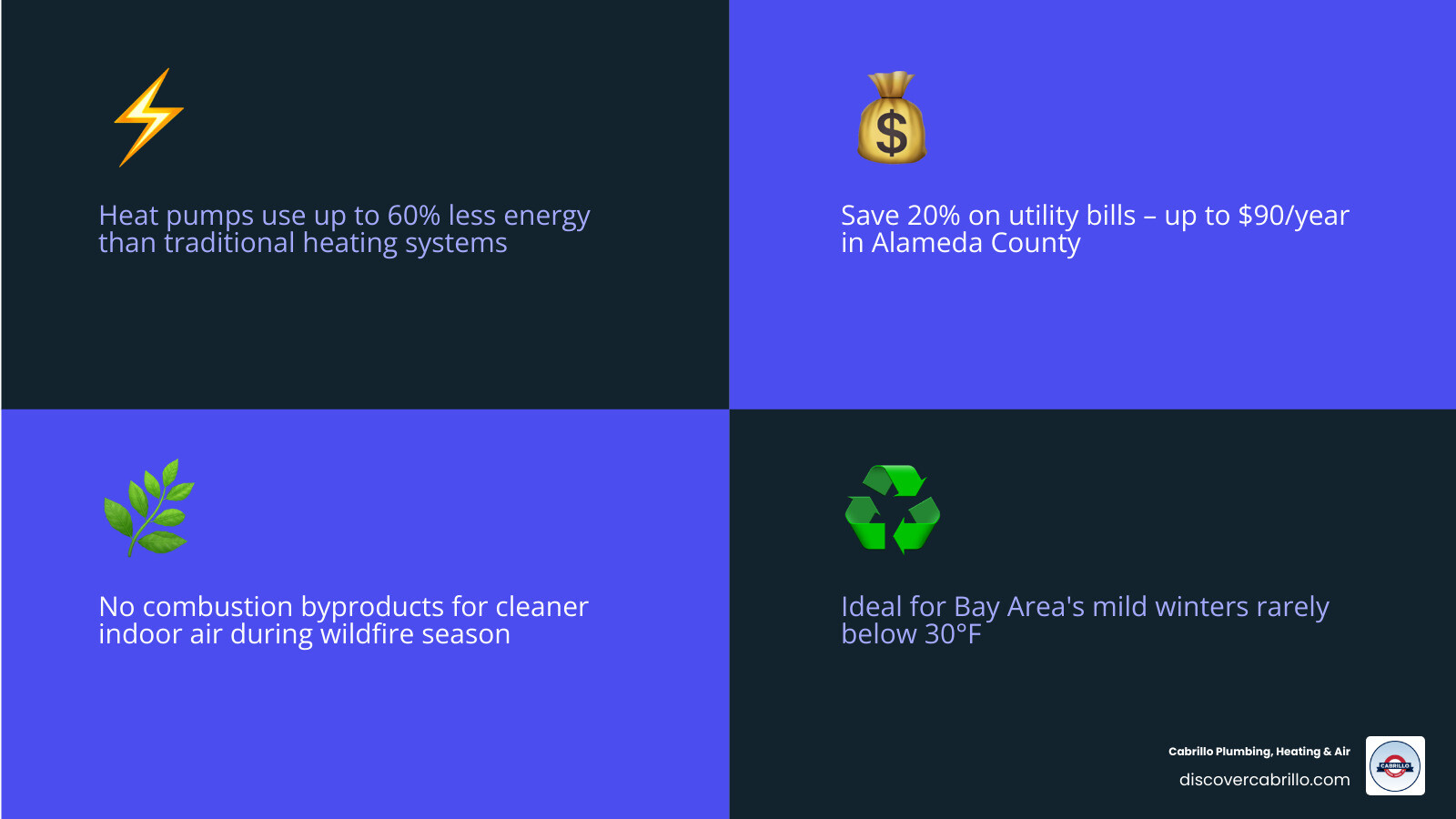
- Energy efficiency: Heat pumps can use up to 60% less energy than traditional heating systems and are up to four times more efficient than a gas furnace
- Cost savings: PG&E customers who switch can save around 20% on utility bills — up to $78 per month — while Alameda County residents see an average of $90 in annual savings
- Year-round comfort: One system handles both heating and cooling, replacing your furnace and air conditioner
- Cleaner indoor air: No combustion indoors means no byproducts — and advanced filtration helps during wildfire season
- Reduced carbon footprint: Heat pumps move heat using electricity instead of burning fossil fuels
- Strong financial incentives: Federal tax credits, BayREN rebates, and programs like Clean HEET can significantly offset installation costs
- Climate-perfect fit: Bay Area winters rarely drop below 30°F — the sweet spot where heat pumps operate at peak efficiency
The Bay Area is one of the best places in the country to own a heat pump. Mild winters mean these systems rarely have to work hard to keep your home warm. Warm summers mean you still need reliable cooling. A heat pump handles both — efficiently and quietly — in a single unit.
At the same time, Bay Area homeowners are dealing with real pressure: rising PG&E rates, increasing wildfire smoke events, and a state that is actively phasing out gas appliances. A heat pump addresses all three.
This guide walks you through everything you need to know — from how heat pumps work in San Francisco’s specific climate, to which rebates you can stack, to what installation and maintenance actually look like in practice.
How Heat Pumps Work in the Bay Area Climate
To understand why we are so excited about this technology, you first have to understand How Does A Heat Pump Work A Guide For San Francisco Area Homeowners. Unlike a furnace, which creates heat by burning natural gas, a heat pump doesn’t actually “make” heat. Instead, it moves it.
Think of it like your kitchen refrigerator, but in reverse. Your fridge pulls heat out of the insulated box to keep your milk cold and dumps that heat into your kitchen. A heat pump uses a similar refrigerant cycle to pull ambient heat from the outside air and move it into your living room.
Even when it feels chilly in San Francisco or Oakland, there is still plenty of thermal energy in the air. The system uses a compressor and a reversing valve to change the direction of the refrigerant flow. This means in the summer, it reverses the process, pulling heat out of your house and dumping it outside, acting as a high-efficiency air conditioner. This dual-functionality is one of the biggest Everything You Need To Know About Heat Pumps In San Francisco.
Comparing Heat Pumps to Traditional HVAC Systems
When we talk to neighbors in South San Francisco or San Mateo, they often ask how these systems stack up against the old-school furnace-and-AC combo. The differences are striking, especially regarding efficiency and safety.
| Feature | Traditional Gas Furnace + AC | Modern Heat Pump System |
|---|---|---|
| Energy Source | Natural Gas (Heat) + Electric (Cooling) | 100% Electric |
| Efficiency | Max 98% AFUE | 300% – 400% (COP of 3.0+) |
| Combustion | Burns fuel inside the home | Zero indoor combustion |
| System Count | Two separate units | One integrated system |
| Environmental Impact | High carbon emissions | Low emissions (Zero with solar) |
While a high-end gas furnace might reach 98% efficiency (meaning 2% of the energy is wasted), a heat pump can reach 400% efficiency. This sounds like magic, but it’s just physics: it takes much less energy to move heat than it does to create it. For every dollar of electricity you put in, you get $3 to $4 worth of heat out. This is a core part of Everything You Need To Know About South San Francisco Heat Pumps.
Why the San Francisco Climate is Ideal for Heat Pump Technology
Geography plays a huge role in HVAC performance. In a place like Minnesota, a heat pump has to work incredibly hard because there is very little ambient heat in sub-zero air. But here in the Bay Area, our “mild” climate is the perfect playground for this technology.
Whether you are in San Jose, Palo Alto, or Walnut Creek, our temperatures rarely dip below 30°F. This is the “sweet spot” where heat pumps are most efficient. Because we don’t have extreme temperature swings, the system can often run at part-load performance. Modern variable-speed compressors allow the unit to “sip” electricity, maintaining a perfectly steady temperature rather than constantly cycling on and off.
Furthermore, our coastal influence means we deal with humidity. Heat pumps are actually superior to standard AC units at dehumidifying your home, which keeps you feeling cooler at higher temperatures during those rare Bay Area heatwaves. If you are considering Heat Pump Installation San Jose Ca, you’ll find the comfort levels are much more consistent than with traditional systems.
Exploring the Many Heat Pump Benefits for Bay Area Homeowners
The list of 4 Benefits Of Installing A Heat Pump Heating System In Your Bay Area Home starts with efficiency but ends with a better quality of life. By switching to an all-electric system, you are essentially future-proofing your home. California is moving toward a 2030 ban on new gas furnace sales, and many local districts are already pushing for zero-emission systems.
When you look at the heat pump benefits for bay area homeowners, the environmental impact is massive. Heat pumps can reduce electricity use for heating by up to 75% compared to electric resistance heaters (like baseboard or wall heaters). If you are moving away from gas, you are achieving fossil fuel independence. This is a major factor for those looking into Heat Pump Replacement San Francisco Ca.
How do heat pump benefits for bay area homeowners improve indoor air quality?
We’ve all seen how air quality can shift during wildfire season. One of the less-talked-about heat pump benefits for bay area homeowners is the massive improvement in indoor air quality (IAQ).
Traditional furnaces require combustion, which can occasionally lead to carbon monoxide risks or the release of particulate matter inside the home. Heat pumps have zero indoor combustion. Furthermore, many modern units are compatible with advanced filtration systems, including HEPA-grade filters that trap smoke, dust mites, pet dander, and pollen.
In cities like San Jose, where wildfire smoke can become a seasonal concern, having a system that constantly circulates and scrubs the air without adding combustion byproducts is invaluable. This is why many families are choosing Heat Pump Replacement San Jose Ca as a health-first upgrade.
What are the long-term energy savings and heat pump benefits for bay area homeowners?
Let’s talk numbers. While we don’t give specific quotes without seeing your home, the regional data for April 2026 is very encouraging. Replacing Your Old Heater With A Shiny New Sf Heat Pump is one of the most effective ways to lower your monthly overhead.
- Utility Bill Reductions: PG&E customers can see savings of about 20% on their utility bills.
- Annual Savings: Homeowners in Alameda County save an average of $90 per year, while some regional estimates suggest total annual savings of $300 to $400 compared to traditional gas/electric setups.
- Solar Pairing: If you have solar panels (or plan to get them), a heat pump is a game-changer. You can use your self-generated clean energy to heat and cool your home, potentially bringing your HVAC operating costs down to nearly zero.
Whether you need Heat Pump Repair Service Oakland Ca or a full system upgrade, the long-term ROI is bolstered by the fact that these units handle two jobs at once.
Financial Incentives, Rebates, and the Clean HEET Program
If the technology sounds great but the investment gives you pause, you’ll be happy to know that 2026 is a “golden era” for incentives. There are several layers of Federal Tax Credits For Heat Pump And Water Heater Upgrades that you can stack to bring down the net cost.
- The Inflation Reduction Act (IRA): This provides a federal tax credit of 30% of the total project cost, capped at $2,000 per year for heat pumps.
- BayREN Incentives: The Bay Area Regional Energy Network offers incentives starting at $1,000 for qualifying installations.
- TECH Clean California: This statewide program provides additional rebates that can often be combined with local utility offers.
If you are looking for Heat Pump Repair Service San Jose Ca, we can help you evaluate if a repair or a rebate-subsidized replacement makes more financial sense.
Maximizing Savings with the Clean HEET Program
One of the most exciting local opportunities right now is the Clean HEET (Clean Heating Efficiently with Electric Technology) Program. This initiative by the Bay Area Air Quality Management District (BAAQMD) is specifically designed to reduce wood smoke pollution.
If you have an old wood-burning stove, insert, or fireplace, you could be eligible for significant grant funding to replace it with a heat pump.
- Base Grants: These range from $3,000 to $6,500 depending on the age of your wood-burning device.
- Maximum Funding: Eligible homeowners can receive up to $10,500 in total if they qualify for low-income “plus-ups” or are replacing multiple devices.
- Deadline: The current application period is open until July 14, 2026.
This program is a “first-come, first-served” initiative, so it pays to act quickly. If you’ve been searching for Heat Pump Repair Service San Francisco Ca but realize your old heating source is a polluting wood stove, this grant could cover a massive portion of your upgrade.
Upfront Rebates for Middle and Low-Income Households
We believe comfort shouldn’t be a luxury. For middle-income households (with a household income below $200,000), there are upfront rebates available for up to $7,000. Low-income households can often qualify for an additional $7,000, making the transition nearly cost-neutral in some cases.
Programs like Peninsula Clean Energy also offer zero-interest loans (up to $10,000 over 10 years) to help bridge any remaining gap. By stacking these with Heat Pump Installation Oakland Ca, you can move to a cleaner, more efficient home without the massive upfront financial burden.
Key Considerations for Installation and Maintenance
A heat pump is a precision instrument. It isn’t a “plug-and-play” appliance like a toaster. To get the full heat pump benefits for bay area homeowners, the installation must be handled correctly. This starts with a Manual J load calculation. We don’t guess the size of your system based on square footage alone; we look at your insulation, window types, and local microclimate to ensure the system isn’t oversized (which leads to short-cycling) or undersized (which leads to discomfort).
When you book Heat Pump Installation San Francisco Ca, we also look at:
- Electrical Panel Capacity: Since you are moving from gas to electric, we check if your panel can handle the new load. Often, because heat pumps are so efficient, a full service upgrade isn’t necessary, but a new circuit is usually required.
- Ductwork Integrity: A high-efficiency heat pump will underperform if your ducts are leaky. We inspect and seal ducts to ensure the air actually reaches your rooms.
- Refrigerant Charge: Precision is key here for system longevity.
Essential Maintenance for System Longevity and Efficiency
Once your system is in, you want it to last. A well-maintained heat pump in the Bay Area typically lasts 10 to 15 years. Because it works year-round (heating in winter, cooling in summer), it does require consistent care.
Following The Ultimate Sf Heat Pump Maintenance And Tune Up Checklist and these 4 Heat Pump Maintenance Tips For Bay Area Homeowners will keep your system running at peak COP:
- Change Filters Monthly: Dirty filters restrict airflow and force the compressor to work harder.
- Clean the Coils: Outdoor coils can get hit with dust and debris. A quick cleaning ensures efficient heat transfer.
- Check Refrigerant Levels: Leaks are rare but can kill efficiency and harm the environment.
- Schedule Annual Tune-ups: Professional inspections catch small issues before they become expensive repairs.
Regular Heat Pump Maintenance San Francisco Ca is the best way to protect your investment.
Choosing Between Ducted and Ductless Mini-Split Systems
Not every home has (or wants) ducts. If you are doing a garage conversion in Menlo Park or a home addition in Burlingame, a ductless mini-split might be the better choice.
- Ducted Systems: Best for homes that already have a central duct network in good condition.
- Ductless Mini-Splits: These consist of an outdoor unit connected to small, wall-mounted indoor air handlers. They allow for “zoned comfort,” meaning you can keep your bedroom cool without wasting energy on an empty living room.
Both types offer the same efficiency benefits. If you need Heat Pump Maintenance Oakland Ca, our team is trained on both central and mini-split technologies.
Conclusion
The transition to electric heating and cooling is a “quiet revolution” happening right now across the Peninsula and the East Bay. Between the environmental impact, the massive reduction in energy waste, and the thousands of dollars in available grants and tax credits, there has never been a better time to make the switch.
Finding A Trusted Heat Pump Company In The City By The Bay is about finding a partner who understands the local climate and the complex web of available rebates. At Cabrillo Plumbing, Heating & Air, we’ve been serving this community since 1961. We don’t just install equipment; we design comfort solutions that last.
Whether you are in San Francisco, San Mateo, or need Heat Pump Maintenance San Jose Ca, we are here to help you future-proof your home.
Frequently Asked Questions
How long does a heat pump last in the Bay Area? A well-maintained heat pump typically lasts 10-15 years. Because it serves as both your heater and your air conditioner, it sees more use than a standalone furnace, making annual maintenance critical for reaching that 15-year mark.
Will a heat pump work during a San Francisco heatwave? Absolutely. In cooling mode, a heat pump is essentially a high-efficiency central air conditioner. As long as the system is properly sized for your home’s heat load, it will keep you perfectly cool even when temperatures spike into the 90s or 100s.
Do I need a backup furnace for cold mornings? In the Bay Area, a backup furnace is almost never necessary. Most modern heat pumps come with an auxiliary electric heat strip for the rare occasions when you need a quick temperature boost or during a defrost cycle. Because our winters are so mild, your heat pump will handle 99% of the year entirely on its own.