
How a New HVAC System Increases Home Value — and Why Bay Area Sellers Are Paying Attention
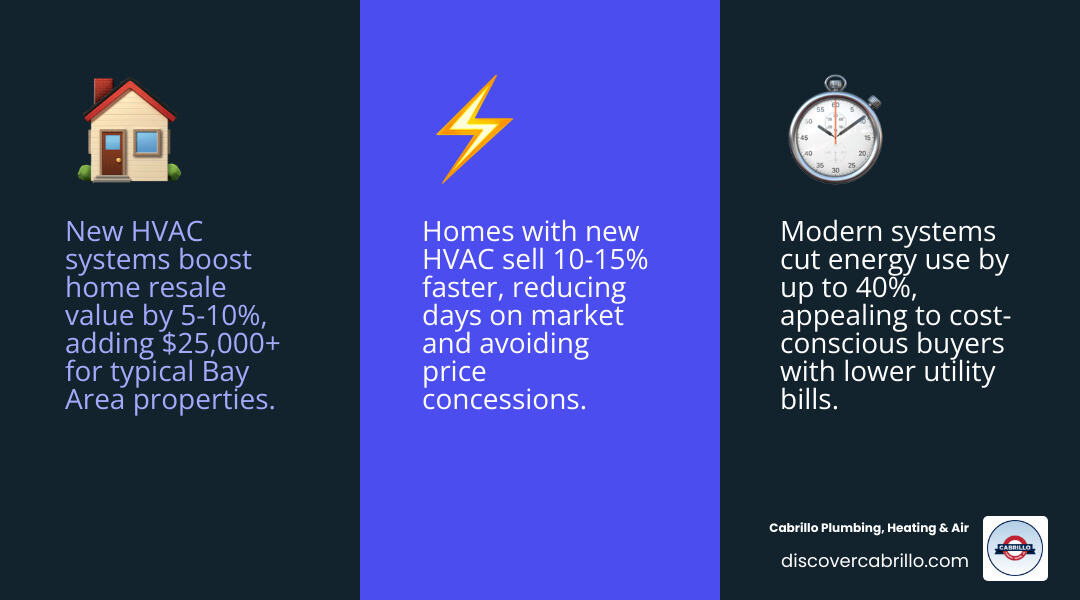
How a new HVAC system increases home value is one of the most financially meaningful questions a homeowner can ask before listing a property — and the answer is backed by real data. According to industry research, a new HVAC system can add 5% to 10% to a home’s resale value, with homes selling 10% to 15% faster when buyers know the heating and cooling system is new. For a Bay Area home, those percentages can translate into tens of thousands of dollars.
Here’s a quick summary of the key ways a new HVAC system adds value:
- Resale value boost: Typically 5% to 10% of home value, or $2,500 to $35,000+ depending on home price
- Faster sale: Homes with new HVAC systems sell 10–15% faster than comparable homes with older systems
- Appraisal credit: Appraisers commonly adjust valuations upward by $2,000 to $5,000 for new mechanical equipment
- Energy savings: Modern systems reduce energy consumption by up to 40%, a strong draw for cost-conscious buyers
- ROI range: Direct equity ROI sits around 30% to 70%, and can reach 85% to 100% when factoring in avoided price concessions and faster closings
- Buyer confidence: 89% of real estate professionals report that energy-efficient HVAC features speed up sales and increase offer amounts
Buyers today — especially in the competitive San Francisco Bay Area market — are scrutinizing big-ticket mechanical systems before making offers. An aging or failing HVAC system is one of the fastest ways to invite inspection contingencies, price negotiations, and lost deals. A new system, on the other hand, signals that the home has been well cared for and is move-in ready.
In this guide, we’ll walk through exactly how a new HVAC system affects your home’s value, what the ROI looks like for Bay Area homeowners, when it makes sense to replace before selling, and what alternatives exist if full replacement isn’t the right move right now.
Does a New HVAC System Truly Increase a Home’s Value?
In April 2026, the real estate landscape in cities like San Francisco, San Mateo, and Palo Alto is more focused on efficiency than ever before. When we look at the data, the answer is a resounding yes. A new Heating & Air Conditioning system acts as a powerful lever for property appreciation.
While a kitchen remodel might provide the “wow” factor during an open house, a brand-new mechanical system provides the financial security buyers crave. In markets where air conditioning is becoming a necessity rather than a luxury, or where reliable heat is non-negotiable for those chilly Pacific nights, a modern system can increase resale value by 5% to 10%. This isn’t just a subjective boost; it’s a reflection of reduced future liability for the buyer.
The “Invisible” Upgrade Advantage
We often call HVAC an “invisible” upgrade because you can’t see it in the listing photos as easily as a marble countertop. However, its impact on the transaction is massive. Mechanical reliability is the foundation of home maintenance. When a buyer sees a gleaming, newly installed furnace or heat pump, they see a home that won’t require a $10,000+ emergency repair three months after closing.
This “peace of mind” translates directly into home inspection success. Many deals in the Bay Area fall through or enter grueling renegotiations because an inspector flags a 20-year-old unit. By upgrading, you eliminate that hurdle. At Cabrillo, we’ve learned through our About Us story that homeowners who prioritize these core systems are often viewed by buyers as more responsible and trustworthy sellers.
Quantifying the Return on Investment (ROI) for Bay Area Homeowners
For many of our neighbors in Menlo Park or Walnut Creek, home equity represents a significant portion of their net worth. Understanding how a new HVAC system increases home value requires looking at the return on investment (ROI).
On average, homeowners can expect to recoup 30% to 70% of the installation cost in direct home value. However, the “real” ROI is often much higher. When you factor in the avoided price concessions (the $5,000 or $10,000 a buyer might demand off the price for an old unit) and the increased speed of the sale, the total recovered project cost can reach 71% to 100%.
Check out how HVAC compares to other common investments:
| Upgrade Type | Typical ROI | Impact on Sale Speed |
|---|---|---|
| New HVAC System | 71% – 100% (Total) | Very High (10-15% faster) |
| Kitchen Remodel | 70% – 80% | Moderate |
| Bathroom Upgrade | 60% – 70% | Moderate |
| New Roof | 60% – 75% | High |
If you are looking for new investment opportunities, try plumbing and heating upgrades to see a more stable return than many cosmetic fixes.
How a new HVAC system increases home value through energy efficiency
In 2026, sustainability is a top priority for Bay Area residents. Modern systems are designed to meet strict SEER2 standards, which measure cooling efficiency. Upgrading to a high-efficiency heat pump or furnace can cut energy use by up to 40%.
For a potential buyer, a home with a new Air Conditioning Service history and a high-efficiency unit means lower monthly utility bills. In a region with some of the highest energy costs in the country, the promise of saving $100 to $300 a month is a major selling point that justifies a higher asking price.
Impact on Appraisal Valuations
Appraisers look at “functional obsolescence.” If your home has a 20-year-old furnace while the neighbor’s home has a brand-new Energy Star-certified system, the appraiser will adjust your home’s value downward. Conversely, a new Heating Service installation often earns a specific upward adjustment of $2,000 to $5,000 on the appraisal report. This can be the difference between a mortgage being approved or a deal falling through because of a low valuation.
Key Factors Influencing How a New HVAC System Increases Home Value
Not all HVAC upgrades are created equal. Several factors dictate just how much your net worth will grow following an installation:
- System Age: Replacing a 15-year-old system provides a much larger value jump than replacing a 7-year-old one.
- Smart Home Integration: Systems that include smart thermostats and zoning capabilities appeal to the tech-savvy workforce in Silicon Valley and San Francisco.
- Indoor Air Quality (IAQ): In the post-pandemic era, buyers pay a premium for HEPA filtration and advanced air purifiers that reduce allergens by 80% to 95%.
How a new HVAC system increases home value in the San Francisco Bay Area
Our local climate is unique. From the fog of Daly City to the heat of Concord and Lafayette, we deal with microclimates that put specific demands on HVAC systems. Furthermore, California’s electrification trends are pushing many homeowners toward heat pumps.
In San Francisco real estate, where space is at a premium, a compact, high-efficiency system that meets all local codes is a massive asset. Buyers in our region are increasingly looking for “all-electric” ready homes, making heat pump installations a gold standard for ROI in 2026.
The Role of Warranties and Documentation
A new system is only as valuable as the paperwork behind it. Buyers love transferable warranties. If your new system comes with a 10-year parts and labor warranty, that is 10 years of “zero risk” for the new owner.
When you save money by calling a contractor who provides professional installation and permits, you create a paper trail that proves the job was done right. We always recommend keeping a folder with all service records and certifications to present to serious bidders.
Strategic Timing: Replacing Your System Before Selling
If your system is approaching its 15th birthday, you are in the “red zone.” Replacing it now, before you list the home, is often a smarter move than waiting for a buyer to find a problem.
When you replace the system proactively, you control the narrative. You can market the home as “featuring a brand-new, high-efficiency HVAC system.” If you wait for the inspection to fail, you lose your leverage and often end up paying for the replacement anyway, but without the benefit of the marketing “boost.”
Pros and Cons of Pre-Sale Replacement
Pros:
- Market Speed: Your home stands out as “move-in ready.”
- Higher Offers: You attract buyers who don’t have the cash on hand for immediate repairs.
- Negotiating Power: You can hold firm on your price because the big-ticket items are already handled.
Cons:
- Upfront Capital: You have to pay for the system before you get the house proceeds.
- Timing: You need to schedule the work a few weeks before listing to ensure everything is perfect.
Alternatives to Full Replacement That Still Boost Appeal
If a full replacement isn’t in the budget, you can still increase your home’s appeal through targeted maintenance. Top 4 Benefits of HVAC Preventive Maintenance include improved efficiency and a longer lifespan, both of which look great to a buyer.
Other high-impact, lower-cost alternatives include:
- Professional Tune-ups: A certified technician’s stamp of approval.
- Duct Sealing: Improves efficiency and comfort without replacing the main unit.
- Smart Thermostat Installation: A relatively inexpensive way to add “modern” appeal.
Leveraging maintenance agreements for buyer confidence
One of the best ways to prove your home has been cared for is to show a history of professional oversight. What are the benefits of enrolling in HVAC maintenance agreements? For a buyer, seeing that the system has been inspected annually by a pro like Cabrillo removes the “fear of the unknown.”
The Value of Documented Preventive Care
In the competitive Bay Area market, transparency wins. Following the ultimate homeowner guide to HVAC maintenance and keeping the logs to prove it can be just as effective as a new unit for a system that is only 5 to 8 years old. It shows the buyer that the “engine” of the home has been well-oiled and is ready for the long haul.
Frequently Asked Questions about HVAC and Home Value
What are the signs that indicate a home’s HVAC system needs to be replaced?
If you’re noticing uneven temperatures between rooms, frequent “cycling” (turning on and off), or if your energy bills have spiked recently, those are red flags. Most importantly, if your system is over 15 years old or uses the phased-out R-22 refrigerant, it’s time to consider a replacement before selling.
How does a new HVAC system impact the speed of a home sale?
Homes with new systems sell 10% to 15% faster. In a “tie-breaker” scenario where a buyer is looking at two similar homes in San Bruno or Burlingame, the one with the new HVAC will almost always win because it represents lower immediate cost and higher comfort.
Do appraisers give credit for high-efficiency heat pumps in 2026?
Yes. With California’s push toward electrification and energy efficiency, appraisers are increasingly trained to recognize the value of Energy Star-certified heat pumps. These systems are viewed as modern mechanical standards that protect the home’s future value.
Conclusion
At Cabrillo Plumbing, Heating & Air, we’ve been helping Bay Area homeowners protect their investments since 1961. Whether you are in San Francisco, Menlo Park, or San Mateo, we understand that your home is your most valuable asset. Investing in a new HVAC system isn’t just about staying cool in the summer; it’s about building equity and ensuring a smooth, profitable sale when the time comes.
By choosing professional installation and keeping up with a Cabrillo Service Agreement, you are telling future buyers that your home is a premium property. Ready to see how a new Heating & Air Conditioning system can boost your net worth? Give us a call today, and let’s make your home the most comfortable—and valuable—one on the block.