

The Real Mini Split vs Central AC Cost Comparison for Bay Area Homeowners
The mini split vs central ac cost comparison comes down to one critical factor: does your home already have ductwork in good condition?
Here’s a quick breakdown to answer your question right away:
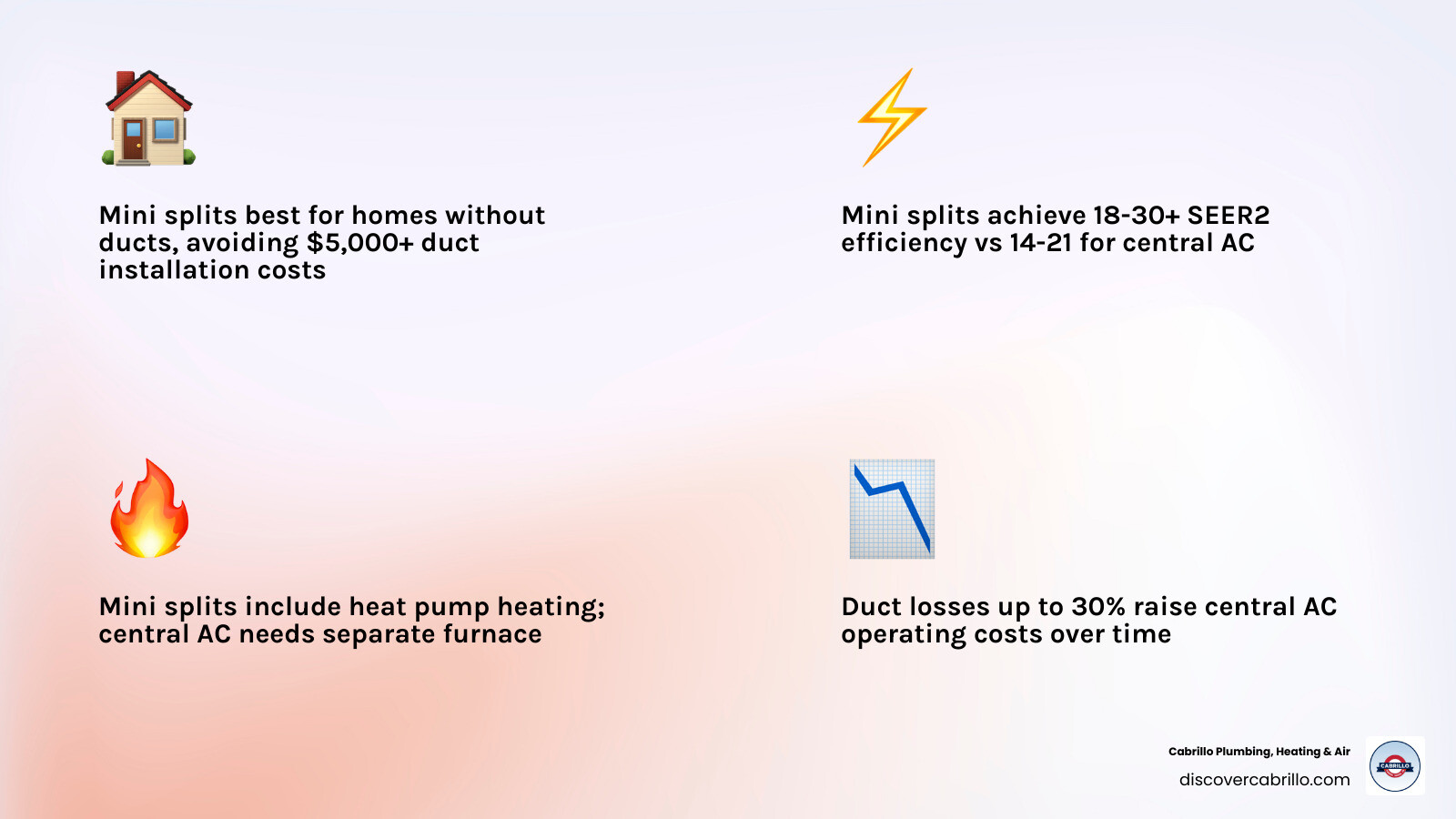
| Factor | Mini Split | Central AC |
|---|---|---|
| Best for homes without ducts | Yes – avoids costly duct installation | No – adds significant expense |
| Best for homes with existing ducts | Comparable or higher upfront cost | Usually lower upfront cost |
| Energy efficiency (SEER2) | 18-30+ | 14-21 |
| Heating included | Yes (heat pump) | No (needs separate furnace) |
| Lifespan | 15-20 years | 12-15 years |
| Zoning capability | Built-in, room by room | Requires add-ons |
| Long-term operating costs | Lower | Higher (duct losses up to 30%) |
If you already have solid, well-sealed ductwork, central AC is often the more affordable choice upfront. If your home lacks ducts – or has old, leaky ones – a mini split system frequently wins on both installation and long-term costs.
For Bay Area homeowners, this decision carries extra weight. Older San Francisco and Peninsula homes often have no ductwork at all, making duct installation a potentially massive added expense. At the same time, the Bay Area’s mild but variable climate makes the heat pump functionality built into most mini splits a genuine year-round advantage.
This guide walks you through every cost layer – installation, energy bills, maintenance, and total ownership – so you can make a confident, informed choice for your home.
Initial Installation Factors for Mini Split vs Central AC Cost Comparison
When we sit down with homeowners in San Mateo or Palo Alto to discuss a new cooling system, the conversation almost always starts with the installation. The complexity of the job is the primary driver of the initial investment.
For a central air conditioning system, the existence and condition of your ductwork is the “hidden monster” of the project. If your home already has a modern, well-sized duct system, AC Installation Replacement San Francisco CA is relatively straightforward. However, many historic homes in San Francisco or older properties in Oakland lack the space for traditional ducts. In these cases, retrofitting ductwork can involve major structural modifications, such as dropping ceilings or building soffits, which adds significant time and labor.
Ductless systems, on the other hand, eliminate this hurdle. A Ductless Mini Split Installation San Francisco CA requires only a small three-inch hole in the wall to connect the indoor air handler to the outdoor condenser. This makes them incredibly flexible for various home layouts, from tight Victorian flats to modern additions. While the equipment itself for a multi-zone mini split can sometimes be more advanced (and thus carry a higher price tag per unit) than a single central AC unit, the lack of invasive construction often makes it the more cost-effective path for homes without pre-existing infrastructure.
Energy Efficiency and Operational Savings
In April 2026, energy efficiency is more than just a buzzword; it’s a necessity for managing Bay Area utility bills. To understand the mini split vs central ac cost comparison, we have to look at how these systems use electricity.
Efficiency is measured by SEER2 (Seasonal Energy Efficiency Ratio) and HSPF2 (Heating Seasonal Performance Factor). Modern central AC units typically range from 14 to 21 SEER2. However, a Ductless Mini Split AC often reaches 20 to 30+ SEER2. Why the big gap? It’s largely due to duct loss. According to the Department of Energy, up to 30% of conditioned air can be lost in ducted systems before it even reaches your living space due to leaks or poor insulation.
Furthermore, mini splits utilize inverter technology. While a standard central AC often operates like a light switch—either 100% on or completely off—inverter-driven, variable-speed compressors act more like a dimmer switch. They ramp up or down to meet the exact cooling demand of the room. This prevents the energy-heavy “start-stop” cycles that drive up bills. To ensure you aren’t paying for more power than you need, we always recommend Sizing an Air Conditioner with a Manual J Load Calculation, which accounts for your home’s specific thermal envelope, including windows, insulation, and local Bay Area microclimates.
Maximizing Efficiency with a Mini Split vs Central AC Cost Comparison
The most significant operational advantage of a mini split is its inherent zoning capability. With a central system, you typically cool the entire house to satisfy one thermostat, even if you are only using the living room. This leads to massive energy waste in unoccupied rooms.
With a Ductless Mini Split Installation San Jose CA, each indoor unit has its own thermostat. You can keep the upstairs bedrooms off during the day while you work in your home office, and then cool the bedrooms only when it’s time for sleep. This occupancy-based cooling can reduce monthly cooling costs by up to 40% compared to a traditional central system. Even if a central system is fitted with zoning dampers, it usually cannot match the granular control and efficiency of a multi-head ductless setup.
Total Cost of Ownership and System Longevity
When we look at the Total Cost of Ownership (TCO) over 10 to 15 years, the math often shifts in favor of the mini split. Central AC systems typically have an average lifespan of 12 to 15 years. Mini splits, because they aren’t forced to push air through miles of ductwork and often use more advanced compressor technology, generally last 15 to 20 years.
There are also 6 Signs It’s Time for an Air Conditioner Replacement to consider, such as rising repair costs or the use of obsolete refrigerants. One of the biggest “value adds” for a mini split is its dual-purpose nature. Most mini splits are actually heat pumps, meaning they provide both cooling in the summer and highly efficient heating in the winter. In the Bay Area’s climate, a mini split can often serve as your primary heat source, potentially allowing you to ditch an old, inefficient furnace entirely.
| Feature | Central AC | Mini Split (Heat Pump) |
|---|---|---|
| Average Lifespan | 12-15 Years | 15-20 Years |
| Maintenance Frequency | Annual Professional | Annual Prof. + Monthly Filter |
| Heating Capability | Cooling Only* | Full Heating & Cooling |
| Duct Requirements | Necessary | None |
*Note: Central AC requires a separate furnace for heat, whereas mini splits are all-in-one systems.
Maintenance Needs for a Mini Split vs Central AC Cost Comparison
Maintenance is vital for protecting your investment, regardless of the system you choose. We often tell our clients that A Quality Air Conditioner Installation is Crucial to the Life and Performance of Your Cooling System, but the care you provide afterward is what keeps it running.
Central systems require quarterly filter changes and periodic duct cleanings to maintain indoor air quality. Mini splits have a different maintenance profile: they require the homeowner to rinse the indoor unit filters every few weeks. This is a simple task, but it’s critical for preventing dust buildup on the coils. For both systems, an annual professional tune-up is essential. During these visits, we perform coil inspections, check refrigerant levels, and ensure electrical components are safe. If you’re looking for AC Installation Replacement Oakland CA, a system is only as reliable as the maintenance program backing it up.
Best Scenarios for Each Cooling Solution
Choosing between these two isn’t about which is “better” in a vacuum; it’s about which fits your specific home scenario in 2026.
When a Mini Split is the Clear Winner:
- Historic Homes: If you live in a classic San Francisco Victorian, you likely don’t have room for ducts. Ductless Mini Splits preserve the architectural integrity of your home.
- Room Additions & Converted Spaces: Adding a bedroom over the garage or finishing a basement? It’s much cheaper to install a mini split than to try and extend your existing ductwork, which might not have the capacity to handle the extra load anyway.
- Problem Rooms: We all have that one room that never stays cool. A single-zone mini split can provide targeted relief without affecting the rest of the house.
When Central AC Still Makes Sense:
- Existing, High-Quality Ducts: If your home was built in the last 20 years and the ducts are in great shape, central AC is likely your most affordable path to whole-home cooling.
- Aesthetics: If you prefer your HVAC system to be completely invisible, the vents of a central system are hard to beat.
- Air Quality Integration: Central systems make it easier to integrate whole-home humidifiers, dehumidifiers, and high-level HEPA filtration systems.
Before making a final choice, it’s important to know How to Size an Air Conditioner for Your San Francisco Area Home. An oversized system will cycle on and off too frequently, while an undersized one will run constantly—both lead to higher bills and early failure. For those in the South Bay, we can help with a Central AC Installation San Jose CA that is perfectly calibrated for your square footage.
Frequently Asked Questions
Is DIY installation a viable option for these systems?
While you might see “DIY-friendly” mini split kits online, we strongly advise against self-installation in the Bay Area. HVAC systems involve high-voltage electricity and pressurized refrigerants. In many of our service areas, such as Oakland or San Francisco, local building codes require permits and inspections for these installations. Furthermore, most manufacturers will void your warranty if the system isn’t installed by a licensed professional. Professional Ductless Mini Split Installation Oakland CA ensures that the refrigerant lines are vacuum-tested and charged correctly, which is the only way to guarantee the 20-year lifespan you’re paying for.
Do both systems provide heating for Bay Area winters?
Traditional central AC units do not provide heat; they are paired with a gas or electric furnace. However, most modern mini splits are heat pumps. They work by reversing the refrigeration cycle—extracting heat from the outside air (even when it’s chilly out) and moving it indoors. This is incredibly efficient for our mild winters. If you’re considering an AC Installation Replacement San Jose CA, a heat pump mini split can offer a “two-for-one” value that a standard AC simply can’t match.
How do noise levels compare between the two options?
Mini splits are notoriously quiet. Because the noisy compressor is located outside and the indoor air handler uses advanced fan blade designs, they often operate at decibel levels as low as 19 dB—roughly the sound of a whisper. Central AC systems are generally louder indoors due to the sound of air rushing through ducts and the vibration of a large central blower motor. If you are a light sleeper or have a home office where you need silence, a mini split is often the superior choice.
Conclusion
The mini split vs central ac cost comparison isn’t just about the price tag on the day of installation. It’s about energy efficiency over the next two decades, the comfort of having the perfect temperature in every room, and the convenience of a system that handles both heating and cooling.
At Cabrillo Plumbing, Heating & Air, we’ve been helping Bay Area residents find their perfect comfort balance since 1961. We understand the unique challenges of our local architecture and microclimates. Whether you’re looking for a Central AC Installation San Francisco CA for a newer home or a cutting-edge ductless system for a historic property, our “by-the-job” pricing ensures you know exactly what to expect.
Ready to see which system will save you more? Give us a call today. We’ll help you run the numbers and find the solution that keeps your home—and your wallet—comfortable for years to come.