
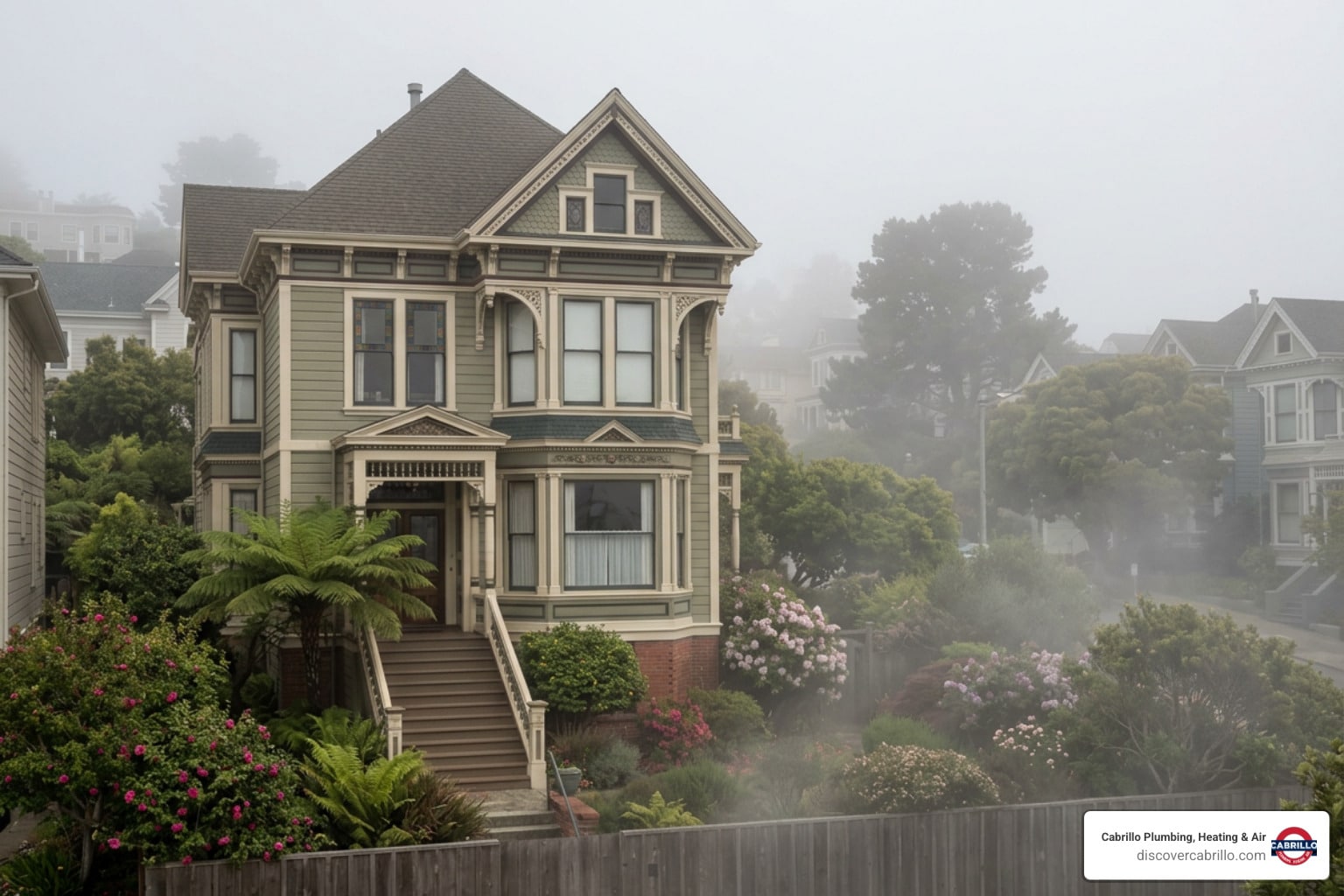
How San Francisco Fog and Wildfire Smoke Affect Your Home — And What You Can Do About It
How san francisco fog and wildfire smoke affect your home is something every Bay Area resident needs to understand, especially as wildfire seasons grow longer and more intense each year. Here’s a quick summary:
How fog and wildfire smoke impact your home:
- Indoor air quality drops fast. Even with windows closed, indoor PM2.5 levels can reach 50–70% of outdoor concentrations during a smoke event.
- Fog traps smoke close to the ground. San Francisco’s marine layer and inversion layers hold pollutants near the surface, prolonging exposure.
- Older homes let in more pollution. Victorian and Edwardian homes with single-pane windows and aging seals allow significantly more smoke infiltration than newer construction.
- Your HVAC system may make things worse. Standard filters do almost nothing to block fine smoke particles, and systems with fresh air intakes can actively pull contaminated air inside.
- Fog adds moisture and salt particles. This accelerates corrosion of HVAC components and creates conditions where mold can thrive alongside smoke residue.
San Francisco’s combination of dense coastal fog and recurring wildfire smoke creates a uniquely challenging environment for homeowners. The fog doesn’t just make the air feel damp — it interacts with smoke particles, alters how pollutants settle, and can make the air inside your home more hazardous than many people realize. Californians’ average smoke exposure was 3.6 times higher during 2017–2023 compared to 2010–2016, and that trend shows no sign of reversing. For Bay Area homeowners, protecting your indoor air quality is no longer a seasonal concern — it’s a year-round priority.
Glossary for how san francisco fog and wildfire smoke affect your home:
How San Francisco Fog and Wildfire Smoke Affect Your Home
When we think of San Francisco weather, we immediately think of Karl the Fog rolling through the Golden Gate. But as June 2026 rolls on, we are increasingly forced to think about how that fog behaves when it collides with wildfire smoke. The unique atmospheric chemistry of the Bay Area means that our local microclimates do not just disperse smoke — they can actually concentrate and trap it inside our living spaces.
To understand how this happens, we have to look at the interaction of the marine layer and inversion layers. When hot, smoky inland air meets our cool, damp coastal breeze, it creates a temperature inversion. This inversion acts like a lid over the Bay Area, pressing the smoke down to ground level. Instead of dispersing into the upper atmosphere, the fine particulate matter (PM2.5) gets suspended in the heavy, humid fog.
Furthermore, the high humidity of coastal fog allows these toxic particles to cling to moisture droplets. When this damp, smoky air infiltrates your home, it brings along corrosive salt particles and concentrated pollutants that settle onto your furniture, walls, and HVAC components. To learn more about preparing your home systems for these complex weather patterns, check out The Bay Area Climate Survival Guide for Your Home Systems.
The Science of How San Francisco Fog and Wildfire Smoke Affect Your Home
Atmospheric chemistry reveals that wildfire smoke is far more complex than simple wood ash. It is a toxic cocktail of PM2.5 (particles 30 times smaller than a human hair), Volatile Organic Compounds (VOCs) like benzene and formaldehyde, and heavy metals. When these pollutants mix with the high humidity of our coastal marine layer, their oxidative potential increases.
Damp air prevents these particles from settling quickly, keeping them airborne longer. Additionally, the salt-laden air characteristic of coastal cities like Pacifica, Daly City, and San Francisco accelerates the breakdown of standard home filtration materials. If you want to dive deeper into how coastal moisture impacts your indoor climate, read our guide on How to Keep Your Home Comfortable in Foggy Weather.
How San Francisco Fog and Wildfire Smoke Affect Your Home Differently Based on Building Age
The age of your home plays a massive role in how much outdoor pollution makes its way inside. In the Bay Area, our housing stock ranges from beautifully preserved 19th-century Victorians in San Francisco and Oakland to modern, airtight builds in San Jose and San Mateo.
- Victorian and Edwardian Homes: These historic properties are notoriously drafty. Built long before modern insulation and air-sealing standards, they feature single-pane windows, original plaster walls, and countless structural gaps. Without intervention, their high air infiltration rates mean that indoor PM2.5 levels can jump to nearly match outdoor levels in a matter of hours.
- Modern Construction: Newer homes feature tight building envelopes designed for energy efficiency. While this keeps smoke out longer, it can also trap indoor pollutants (like cooking grease and VOCs) inside. Without proper mechanical ventilation, a tight home can suffer from stagnant, unhealthy air.
No matter the age of your home, addressing air leaks is a crucial first step. You can discover how sealing these gaps keeps drafty air out by reading How Can Sealing Home Air Leaks Improve Your Home’s Comfort and Efficiency Levels?.
The Health Risks of Combined Fog and Smoke Exposure
Breathing in wildfire smoke is dangerous on its own, but breathing it in when mixed with foggy, humid air increases the health risks. Because fog droplets are easily inhaled deep into the respiratory tract, they act as vehicles, carrying fine particulate matter and toxic gases directly into the alveoli of your lungs.
Scientific studies have shown that wildfire PM2.5 is up to 10 times more harmful than typical industrial or traffic pollution. In California, a mere 10-microgram increase in wildfire-specific PM2.5 has been linked to a 10% jump in respiratory hospitalizations. This exposure causes severe cardiovascular strain, triggers acute asthma attacks, and leads to systemic inflammation. Over time, living in a home with poor indoor air quality can lead to chronic fatigue, headaches, and respiratory distress — a condition often referred to as “sick building syndrome.” To protect your family from these invisible hazards, read about Sick House Syndrome: How Poor Indoor Air Quality Can Take a Toll on Your Health.
Upgrading Your HVAC and Filtration Systems for Maximum Protection
When the Bay Area air turns orange and foggy, your home’s heating and cooling system is your primary line of defense. However, standard 1-inch fiberglass filters (typically rated MERV 8 or lower) are only designed to protect the HVAC equipment from large dust bunnies — they let fine smoke particles pass right through.
To clean your indoor air effectively, you need to upgrade to a MERV 13 or higher filter, or install a dedicated whole-home purification system. It is also important to note that electrostatic filters can lose up to 95% of their efficiency within just a few days of heavy smoke exposure because the particulate matter neutralizes their electric charge. During heavy smoke events, the sheer volume of particles can clog even a high-capacity filter in two to four weeks, compared to the standard three-month lifespan.
If your home uses an Energy Recovery Ventilator (ERV) or Heat Recovery Ventilator (HRV), make sure to switch it to recirculation mode or bypass mode during a smoke event to avoid pulling smoky air from the outside. For a detailed walkthrough on managing your system during these events, check out our Step-by-Step Guide to HVAC Air Filtration During Wildfire Smoke.
| Filter Type | Efficiency on PM2.5 | Target Pollutants | Best Use Case |
|---|---|---|---|
| MERV 13 | ~75% to 90% | Fine dust, mold spores, smoke particles | Standard HVAC systems (check compatibility) |
| HEPA | 99.97% (down to 0.3 microns) | Ultrafine particles, bacteria, allergens | Whole-house purifiers & portable units |
| Activated Carbon | N/A (Gas phase) | VOCs, odors, toxic gases, smoke smell | Combined with HEPA for complete protection |
To explore how these systems integrate seamlessly into your existing ductwork, you can read about how to Improve Your Indoor Air Quality with a Whole House Air Purifier.
Choosing the Right Air Purifier and Filtration Technology
When selecting portable air purifiers or whole-house systems, pay close attention to the Clean Air Delivery Rate (CADR). As a rule of thumb, your purifier’s CADR rating should be at least two-thirds of your room’s square footage. For absolute protection against biological contaminants and chemical odors, we recommend combining HEPA filters with UV air sanitizers and activated carbon.
To find the right system for your Bay Area home, check out our specialized services:
- Explore our main Whole Home Air Purifier Systems San Francisco CA page.
- Schedule a professional Air Purifier Installation San Francisco CA.
- Learn about destroying airborne pathogens with UV Air Sanitizer Installation San Francisco CA.
Creating a Clean Room and Maintaining Your Home’s Air Quality
If sealing your entire home is a work in progress, your best short-term strategy is to set up a dedicated “clean room” or refuge space. This is typically a bedroom or living space with minimal exterior doors and windows. Concentrating your air purification efforts in a single closed room can achieve a 60% to 80% reduction in indoor PM2.5 levels.
Beyond portable purifiers, long-term maintenance is key. Professional air quality testing can identify exactly which pollutants are bypassing your defenses, while thorough duct cleaning prevents accumulated ash from recirculating through your home. For more practical tips, read about How to Improve Indoor Air Quality in Your Home and find out What Can Installing an Air Cleaner Do for Your Home’s Air?.
Actionable Steps Before, During, and After a Smoke Event
To keep your family safe, we recommend following this checklist:
- Before the Smoke Arrives (Pre-Season Prep):
- Stock up on high-efficiency MERV 13 HVAC filters and N95 masks.
- Inspect the weatherstripping around your doors and windows, replacing any worn seals.
- Schedule an annual HVAC tune-up to ensure your fan can handle a denser filter.
- During a Active Smoke Event:
- Keep all windows and doors closed tightly.
- Set your HVAC system to “Recirculation Mode” and run the fan continuously (“On” instead of “Auto”).
- Run your portable HEPA purifiers on high speed in your designated clean room.
- Avoid activities that create indoor particles, such as burning candles, vacuuming without a HEPA filter, or frying food.
- After the Smoke Clears:
- Replace your HVAC filter immediately, as it is likely overloaded with fine ash.
- Perform a thorough cleanup using damp cloths to wipe down surfaces rather than dry sweeping, which kicks settled particles back into the air.
- Slowly ventilate your home only after the outdoor Air Quality Index (AQI) drops below 50.
For a closer look at how local weather patterns dictate your home comfort needs, consult The Best HVAC Options for San Francisco Microclimates: A Local Guide.
Frequently Asked Questions about Fog and Wildfire Smoke
Can wildfire smoke enter my home if all windows and doors are closed?
Yes. No residential home is completely airtight. Outdoor air naturally infiltrates through tiny gaps around windows, plumbing penetrations, electrical outlets, and attic hatches. Without active filtration, indoor PM2.5 levels can reach 40% to 60% of outdoor levels even with everything shut.
How often should I replace my HVAC filter during wildfire season?
Under normal conditions, filters last about three months. However, during active wildfire smoke events, the heavy volume of particulate matter can clog a filter in as little as two to four weeks. We recommend checking your filter weekly during smoke season and replacing it as soon as it looks grey or dirty.
Does coastal fog make wildfire smoke more dangerous to breathe?
Yes. The high humidity of coastal fog prevents smoke particles from dispersing and allows them to bind to water droplets. This makes the particles heavier and easier to inhale deep into your lungs, which can increase respiratory irritation and cardiovascular strain.
Conclusion
Protecting your home from the combined forces of San Francisco’s heavy fog and seasonal wildfire smoke requires a proactive, multi-layered approach. From upgrading your HVAC filters to sealing up drafty older homes, taking these steps ensures your indoor living space remains a safe, healthy sanctuary.
At Cabrillo Plumbing, Heating & Air, we have been helping Bay Area homeowners breathe easier since 1961. We charge by the job, not the hour, and offer top-tier warranties alongside our annual maintenance programs to give you year-round peace of mind. Whether you live in San Francisco, Menlo Park, Belmont, or South San Francisco, our expert team is here to help. Contact us today to schedule your professional Indoor Air Quality assessment!