
Wildfire Smoke Is Inside Your Home Too — Here’s What Bay Area Homeowners Need to Know
HVAC and air filtration during wildfire smoke season is one of the most important steps Bay Area homeowners can take to protect their families from dangerous air pollution. When smoke rolls in — whether from nearby hills or fires hundreds of miles away — your indoor air can quickly become just as hazardous as the air outside.
Quick answer: How to protect your indoor air during wildfire smoke
- Upgrade your HVAC filter to MERV 13 or higher before smoke season begins
- Switch your thermostat fan from “Auto” to “On” so air keeps circulating through the filter
- Close fresh air intakes and set your system to recirculate indoor air only
- Run a portable air cleaner (HEPA-rated) in the room where you spend the most time
- Check your filter every few days during heavy smoke — replace it when it looks dark brown or black
- Keep windows and doors closed and avoid indoor activities that add more particles to the air
Wildfire seasons in the U.S. have grown dramatically. Between 2013 and 2022, the country averaged over 61,000 wildfires per year. In 2024 alone, nearly 9 million acres burned. And smoke doesn’t stay outside — research shows that indoor PM2.5 levels typically reach 55 to 60 percent of outdoor levels even when windows are closed, without any filtration in place.
For Bay Area homeowners, this is no longer a once-in-a-decade concern. It’s a seasonal reality. The good news is that the right HVAC settings, filter upgrades, and air cleaners can meaningfully reduce your family’s exposure. This guide walks you through every step — before, during, and after a smoke event.
How wildfire smoke affects your home’s air and health
Living in the Bay Area, we are used to the morning fog, but wildfire smoke is a different beast entirely. It is a complex mixture of gases and fine particles produced when wood and other organic materials burn. The biggest threat to your health is microscopic “fine particulate matter,” known as PM2.5. These particles are less than 2.5 microns in diameter—so small they can bypass your body’s natural defenses and travel deep into your lungs and even enter your bloodstream.
Why indoor air can still get polluted during hvac and air filtration during wildfire smoke season
Many homeowners in San Francisco or San Jose believe that simply closing their windows and doors is enough to keep the smoke out. Unfortunately, homes are not airtight. Smoke enters through “infiltration” paths—small openings, joints, and cracks in the building envelope. It also travels through duct leaks in unconditioned spaces like attics or crawlspaces.
If your HVAC system has a fresh air intake and isn’t adjusted, it can actually pull smoke directly from the outside into your living room. Without proper filtration, indoor PM2.5 concentrations can reach 50% to 80% of outdoor levels.
Health risks of wildfire smoke indoors
Poor indoor air quality isn’t just a nuisance; it can lead to serious health issues. Short-term exposure can cause throat irritation, headaches, and stinging eyes. For those with pre-existing conditions like asthma or COPD, smoke can trigger severe attacks.
Long-term, these particles are linked to heart disease and reduced lung function. Vulnerable groups, including children, older adults, and pregnant people, are at the highest risk. This is often referred to as Sick House Syndrome: How Poor Indoor Air Quality Can Take a Toll on Your Health, where the air inside your home makes you feel ill. Understanding How Do Airborne Particles Get Into the Air in Our Homes is the first step toward stopping them.
Step 1: Prepare your HVAC system before smoke season starts
In the Bay Area, smoke season usually hits its peak in late summer and autumn, but preparation should start in May or June. Waiting until the sky turns orange is too late—filters often sell out, and HVAC technicians get booked up quickly.
Preseason Smoke-Readiness Checklist:
- Schedule a professional HVAC inspection to check for duct leaks and system health.
- Verify if your system can handle high-efficiency filters.
- Purchase at least 2-3 spare high-efficiency filters.
- Identify a “cleaner air room” in your home.
- Check that all windows and doors have intact weatherstripping.
Check whether your system can handle a higher-efficiency filter
Not all systems are designed to push air through a thick, dense filter. Before you buy the highest-rated filter on the shelf, you need to understand What is the MERV Rating of an Air Filter. MERV stands for Minimum Efficiency Reporting Value. For wildfire smoke, you want a MERV 13 filter or higher.
However, high-MERV filters create more “static pressure” (resistance). If your system is older, a MERV 13 filter might restrict airflow too much, causing the motor to burn out. It’s important to know What are the Different Types of Air Filters for Your House and consult with a professional to ensure your furnace or heat pump can handle the upgrade. Never “double up” filters, as this will almost certainly damage your equipment.
Seal the home and reduce smoke entry points
Your home’s “envelope” is its first line of defense. Check for gaps around recessed lights, attic bypasses, and plumbing stacks. Use weatherstripping on doors and windows. If you have a commercial-style economizer on your HVAC system, ensure you know how to disable it so it doesn’t bring in smoky outdoor air during an event.
Stock supplies before wildfire alerts begin
Preparation is key to How to Improve Indoor Air Quality in Your Home. Beyond HVAC filters, keep a portable air cleaner ready, a low-cost PM2.5 monitor to track indoor levels, and N95 masks for when you absolutely must go outside.
Step 2: Use the right HVAC settings during an active smoke event
When the Air Quality Index (AQI) starts to climb, how you run your system changes. Usually, we want fresh air, but during smoke season, we want to isolate.
Best hvac and air filtration during wildfire smoke season settings for central air, furnaces, and heat pumps
The most important move is to switch your thermostat fan setting from “Auto” to “On.” In “Auto” mode, the air is only filtered when the system is actively heating or cooling. In “On” mode, the fan runs continuously, meaning your air is being pulled through that high-efficiency filter 24/7.
Ensure your system is set to “Recirculate.” If your HVAC has a fresh air damper, close it. This prevents the system from sucking in the smoke you’re trying to avoid. Knowing What You Need to Know About Your Central Air Conditioner Filter ensures you aren’t accidentally making your air worse.
What not to do when outdoor air quality is poor
- Don’t use whole-house fans: These are designed to pull outdoor air in, which is the last thing you want.
- Avoid indoor pollutants: Don’t burn candles, fry food, broil meat, or use a vacuum without a HEPA filter. These activities create more indoor particles.
- Skip the “ozone” cleaners: Some air purifiers produce ozone as a byproduct, which is a lung irritant—exactly what you’re trying to avoid.
How to create a cleaner-air room inside your home
If your whole-house system is struggling, designate one room (ideally a bedroom) as a “cleaner-air room.” Keep the door closed, seal the gap at the bottom with a towel or draft stopper, and run a portable air cleaner on high. This provides a safe haven for sleeping. You can learn more about The Benefits of Using an Air Purifier for Allergies, which apply directly to smoke particles too.
Step 3: Choose the best filtration setup for wildfire smoke
There are several ways to scrub the air, ranging from simple filter swaps to advanced whole-home systems.
How effective are MERV 13 filters and portable air cleaners?
Research indicates that using portable air cleaners can reduce indoor PM2.5 by an average of 56%. High-efficiency HVAC filters (MERV 13+) can capture up to 90% of smoke particles. For the ultimate protection, HEPA (High-Efficiency Particulate Air) filters are the gold standard, capturing 99.97% of particles as small as 0.3 microns.
| Feature | MERV 13 HVAC Filter | Portable HEPA Cleaner |
|---|---|---|
| Particle Removal | High (Up to 90%) | Superior (99.97%) |
| Coverage | Whole House | Single Room |
| Gas/Odor Removal | Low (unless carbon-coated) | High (if it has carbon) |
| Noise | Quiet | Moderate |
To maximize your defense, consider how to Improve Your Indoor Air Quality with a Whole House Air Purifier and check out What is a HEPA Filter for deeper technical details.
DIY air cleaners vs commercial portable air cleaners
If commercial units are sold out, you can build a “Corsi-Rosenthal Box.” This involves taping four or five MERV 13 filters to a standard 20-inch box fan. While these are noisier and less “polished” than commercial units, they are incredibly effective at moving a lot of air and reducing PM2.5 in a pinch.
When whole-home air cleaning makes sense
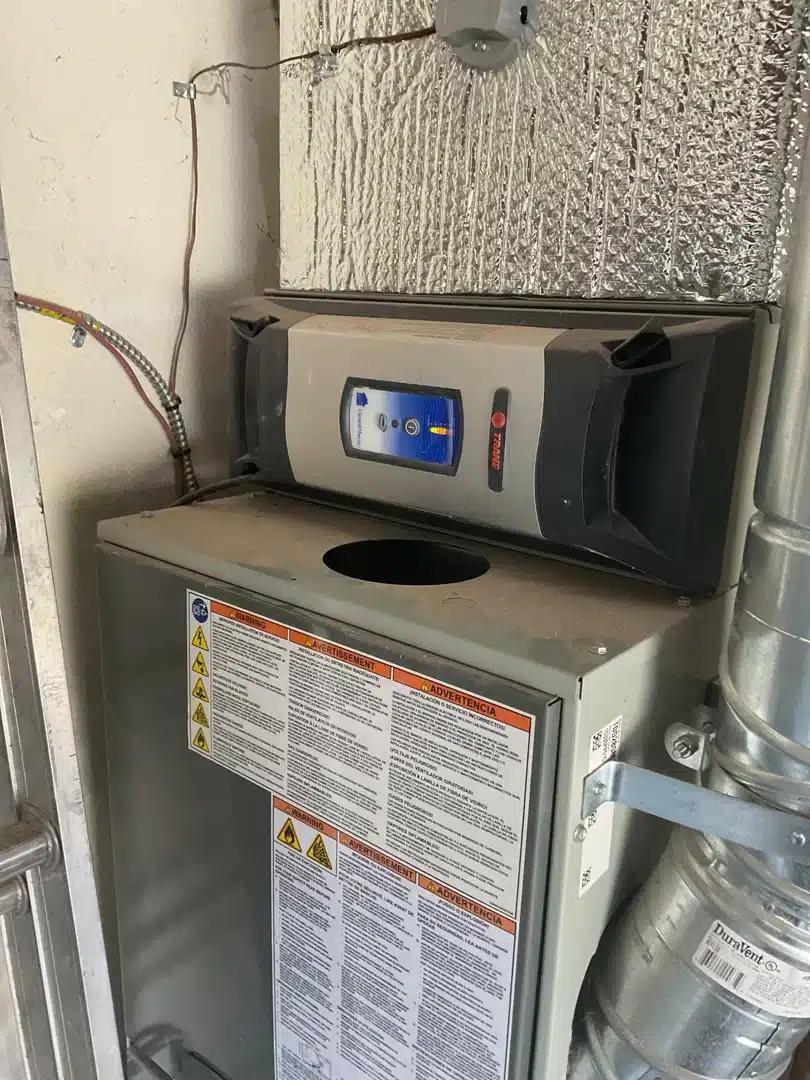
For long-term protection in the Bay Area, an Indoor Air Quality system integrated into your ducts is often the best choice. These systems, like an electronic air cleaner or a whole-home HEPA bypass, work alongside your furnace or heat pump.
What Can Installing an Air Cleaner Do for Your Home’s Air? It provides a layered defense that handles the entire house at once. There are 5 Reasons to Install an Electronic Air Cleaner, including lower maintenance and higher capture rates for microscopic soot. We specialize in Whole Home Air Purifier Systems San Francisco CA to keep your family breathing easy year-round.
Step 4: Maintain filters and air cleaners throughout smoke season
Maintenance is not a “set it and forget it” task during a smoke event. The sheer volume of particles in the air can clog a filter in days rather than months.
How often to check and replace filters during prolonged smoke exposure
During heavy smoke, check your HVAC filter every 3 to 5 days. If the filter looks dark grey, brown, or black, it is “loaded” and needs to be replaced immediately. A clogged filter restricts airflow, which can lead to 4 Common Symptoms of a Clogged Air Filter like a frozen AC coil or a furnace that shuts down.
Knowing Why is it Important to Change the Air Filter in Your Furnace and Air Conditioner is vital during smoke season because Is a Dirty Air Filter Hindering the Performance of Your Furnace? Yes—it can cause permanent damage. Even if the smoke clears, How Often Should You Change Your Air Filter depends on the severity of the season; you may need to replace it much more frequently than the standard 90-day recommendation.
Cleaning up safely after smoke or ash exposure
Once the air clears, don’t just open the windows and start sweeping. Ash is very fine and easily kicked back into the air. Wear an N95 mask and gloves. Use a damp cloth to wipe down surfaces and a HEPA-rated vacuum for carpets. Avoid dry sweeping or using leaf blowers.
Signs it’s time to call for HVAC and IAQ help
If you notice weak airflow, persistent smoke odors even after the fires are out, or if your system is making strange noises, it’s time to call in the pros. 5 Reasons Pleated Air Filters Out Perform Standard Throwaway Filters is a good read to understand why your choice of filter matters, and you can also learn How Can You Use Your Air Filter for Avoiding Springtime Allergies to get value out of your filtration system all year long.
Long-term indoor air strategy for a smokier future
Climate change is making wildfire seasons longer and more intense. In the Bay Area, we have to plan for smoke as a recurring environmental condition.
Build a Bay Area plan for future wildfire seasons
A resilient home combines seasonal maintenance with smart upgrades. Our annual maintenance program ensures your system is ready before the first spark. We offer professional Air Purifier Installation San Jose CA and Air Purifier Installation Oakland CA to give you a permanent defense system. For those looking for the highest level of sanitization, we also provide UV Air Sanitizer Installation San Jose CA and UV Air Sanitizer Installation San Francisco CA.
Frequently Asked Questions about HVAC Air Filtration During Wildfire Smoke
Can I use a MERV 13 filter in any home HVAC system?
Most systems built in the last 15 years can handle a MERV 13 pleated filter, but it’s always best to have an HVAC professional check your system’s “static pressure” to ensure you won’t damage the blower motor.
Should I run my HVAC fan continuously during wildfire smoke?
Yes. Switching your thermostat to “Fan On” ensures that air is constantly being scrubbed by your filter, even when the heater or air conditioner isn’t running.
Do I need both a portable air cleaner and my HVAC filter?
While a MERV 13 HVAC filter provides great whole-home coverage, adding a portable HEPA cleaner in bedrooms provides an extra layer of protection where you spend the most time.
Conclusion
Protecting your home from wildfire smoke requires a proactive approach. By upgrading your filters, adjusting your HVAC settings, and sealing your home, you can create a safe haven for your family. Don’t wait for the next smoke alert to take action.
For more information on how to protect your home’s air, visit our Indoor Air Quality page or contact us today to schedule a smoke-readiness inspection.