
Why Getting the Right Size HVAC for the San Francisco Bay Area Homes Matters More Than You Think
Getting the right size HVAC for the San Francisco Bay Area homes is one of the most important decisions you’ll make as a Bay Area homeowner — and one of the most misunderstood.
Here’s the short answer most homeowners need:
Bay Area HVAC Sizing at a Glance
| Your Location | Climate Type | Sizing Approach |
|---|---|---|
| San Francisco / Pacifica / Daly City | Coastal, fog-heavy | Smaller capacity, heating-priority, HSPF2-rated heat pump |
| Oakland / Berkeley / Walnut Creek | Moderate to warm | Balanced cooling and heating, Manual J required |
| Concord / Livermore / Antioch | Inland, hot summers | Larger cooling capacity, high SEER2, variable-speed system |
| Peninsula / South Bay | Mild, occasional cold snaps | Heat pump or hybrid system, zoned options |
The golden rule: Never size an HVAC system by square footage alone. Always insist on a Manual J load calculation from a licensed contractor who knows your specific Bay Area microclimate.
The Bay Area is unlike almost any other region in the country. Within just a few miles, you can have 65°F fog rolling through San Francisco while Walnut Creek bakes at 100°F. That kind of temperature swing — sometimes on the same afternoon — makes generic HVAC sizing advice nearly useless here.
An HVAC system that’s too small will run nonstop on hot days, wear out early, and still leave you uncomfortable. One that’s too large will short-cycle, fail to remove humidity, and drive up your energy bills — all while feeling like it’s “working fine.”
The Bay Area’s unique mix of coastal fog, inland heat, older housing stock, and strict California energy standards means sizing an HVAC system here requires real expertise, not guesswork. Whether you live in a 1920s San Francisco Victorian, a mid-century Eichler in the South Bay, or a newer build in Concord, the right approach starts with understanding your home — not just its square footage.
Why Getting the Right Size HVAC for the San Francisco Bay Area Homes is Critical

When we talk about “size” in the HVAC world, we aren’t talking about the physical dimensions of the unit. We are talking about its capacity, measured in BTUs (British Thermal Units) or tons. Getting this number right is the difference between a home that feels like a sanctuary and one that feels like a swampy cave.
A common myth is that “bigger is better.” In reality, A Quality Air Conditioner Installation Is Crucial To The Life And Performance Of Your Cooling System. If a system is mismatched to the home’s needs, it won’t just cost more to run; it will actively damage itself over time.
Risks of Oversized Systems in Coastal Climates
In San Francisco, Daly City, or Pacifica, our main battle is often humidity and mild chill rather than extreme heat. If you install an oversized system, it will reach the thermostat’s target temperature so quickly that it “short-cycles.”
Short-cycling means the system turns on and off rapidly. Because the cooling cycle is too short, the unit never has a chance to remove moisture from the air. This results in “clammy air” — where the room is technically 70°F, but you feel sticky and uncomfortable. Furthermore, the constant starting and stopping puts immense stress on the compressor and blower motor, leading to frequent repairs and a shortened lifespan.
Challenges of Undersized Units During Heatwaves
On the flip side, an undersized unit is a nightmare during a Peninsula heatwave or a Concord summer. If the system is too small, it will run 24/7 without ever reaching your desired temperature. This leads to:
- Sky-high energy bills: The motor never gets a break.
- Premature failure: Components wear out years before they should.
- Poor Air Quality: Constant operation without reaching the proper “off” state can sometimes lead to frozen coils and restricted airflow, which hurts your indoor air quality.
Calculating Your Load: Beyond Square Footage Rules of Thumb
For decades, many contractors used a “rule of thumb” like “one ton of cooling for every 500 square feet.” In May 2026, we know this is dangerously outdated. Modern homes are tighter, and older Bay Area homes are too unique for generic math.
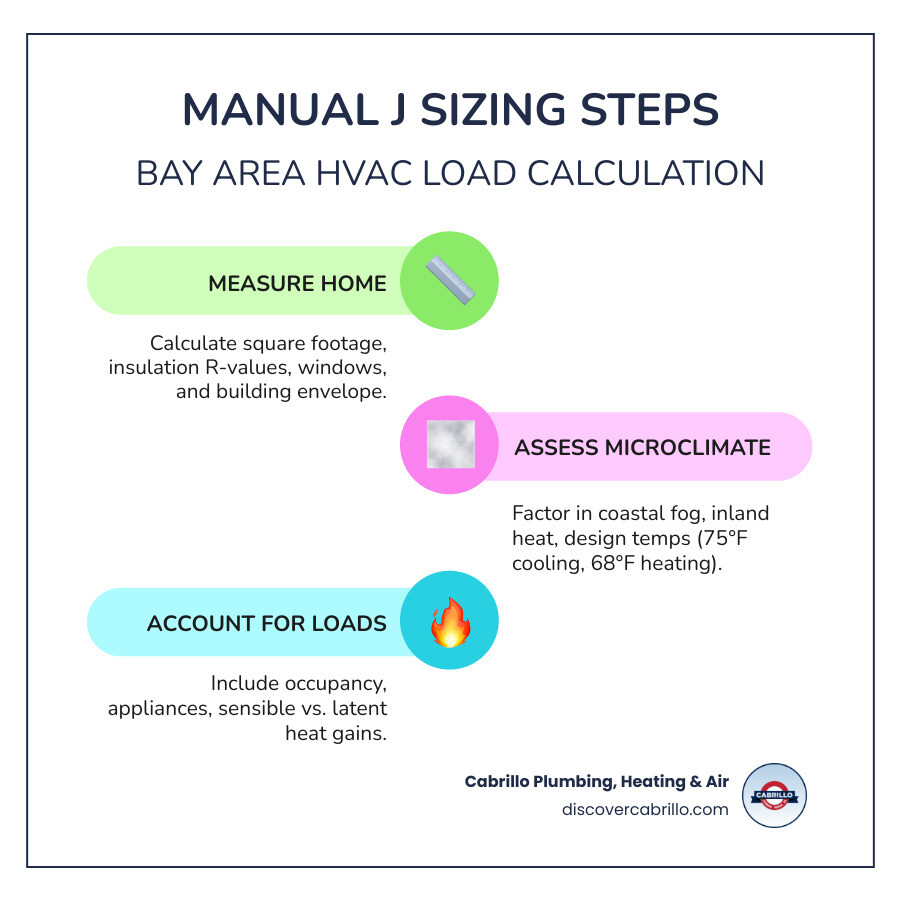
To get it right, we use the Manual J Load Calculation. This is the industry-standard engineering method for determining exactly how much heat your home gains in the summer and loses in the winter.
| Factor | Rule of Thumb (Old Way) | Manual J (The Right Way) |
|---|---|---|
| Home Size | Only looks at floor area | Looks at total volume and ceiling height |
| Windows | Ignored | Factors in orientation (South-facing vs. North) |
| Insulation | Assumed average | Uses actual R-values of walls and attic |
| Occupants | Ignored | Accounts for number of people and heat-producing appliances |
The Role of Manual J in Getting the Right Size HVAC for the San Francisco Bay Area Homes
Sizing An Air Conditioner With A Manual J Load Calculation involves analyzing the “building envelope.” We look at everything: the direction your house faces, the type of roofing you have, and even the internal heat sources like your oven or home office equipment.
We distinguish between “sensible load” (lowering the temperature) and “latent load” (removing moisture). In our region, getting this balance right is essential for comfort.
Assessing Insulation and Ductwork Integrity
You can have the most perfectly sized heat pump in the world, but if your ducts are leaky, you’re throwing money away. California’s Title 24 standards are strict for a reason. Duct systems in new homes must have a leakage rate of 5% or less.
When we evaluate a home, we look for 4 Things To Look For In Proper Duct Design: proper sealing, adequate insulation, correct sizing for airflow (at least 350 CFM per ton), and a layout that doesn’t restrict air. Poor ductwork can waste 20-40% of your system’s capacity.
Navigating Bay Area Microclimates and Local Energy Standards
The Bay Area’s microclimates are legendary. How To Size An Air Conditioner For Your San Francisco Area Home requires knowing if you’re in CEC Climate Zone 3 (Coastal) or Zone 12 (Inland).
Impact of California Title 24 on HVAC Sizing
The 2019 Residential Compliance Manual (and subsequent updates) mandates that heating loads be calculated using an indoor design temperature of 68°F and cooling at 75°F. We must use specific outdoor design conditions from the state’s “Reference Joint Appendix JA2.” These aren’t just suggestions; they are legal requirements to ensure California homes remain energy-efficient.
Microclimate Considerations for Getting the Right Size HVAC for the San Francisco Bay Area Homes
- San Francisco & Pacifica: You might only need cooling 10 days a year, but you need efficient heating year-round. Salt air can also corrode outdoor units, so we look for specialized coatings.
- Concord & Walnut Creek: You face 100°F+ days. Here, we prioritize high-efficiency cooling and variable-speed compressors that can handle the massive diurnal temperature swings (the difference between a hot day and a cool night).
- The Peninsula: Areas like Menlo Park or Palo Alto have a moderate climate where a high-efficiency heat pump is often the “Goldilocks” solution.
Knowing Bay Area Air Conditioning Service What You Should Know helps you choose a system that won’t struggle when the fog lifts or the heat settles in.
Selecting the Best System Type for Your Home Layout
Once we have the size, we have to choose the “engine.”
Why Heat Pumps Excel in the Bay Area Climate
Heat pumps are the superstars of Northern California. Because our winters are mild, heat pumps operate at incredibly high efficiency — often 300% or more. They don’t “create” heat; they move it.
Everything You Need To Know About Heat Pumps In San Francisco is that they provide both heating and cooling in one unit. With the current focus on electrification and available rebates, they are often the most cost-effective long-term choice for our customers.
Solutions for Older Homes and Multi-Story Layouts
Many homes in San Francisco and Oakland lack traditional ductwork. In these cases, ductless mini-splits are a game-changer. They allow for “zoning,” meaning you can cool the upstairs bedroom while leaving the downstairs off.
For South San Francisco Heat Pumps, zoning is particularly helpful in multi-story homes where the top floor can be 10-15°F hotter than the ground floor.
When choosing a system, we always look at the SEER2 rating. This number tells you how much cooling you get for every dollar of electricity. In hotter inland areas, a higher SEER2 (20+) pays for itself much faster than in cooler coastal zones.
Frequently Asked Questions about Bay Area HVAC Sizing
What is the standard “rule of thumb” for sizing?
While many still use the “1 ton per 500 sq. ft.” rule, we advise against it. It fails to account for the Bay Area’s microclimates and modern insulation. A 1,500 sq. ft. home in San Francisco might only need a 1.5-ton unit, while the same home in Concord might require a 3-ton unit.
How do SEER2 and HSPF2 ratings affect my choice?
SEER2 (Seasonal Energy Efficiency Ratio) measures cooling efficiency, while HSPF2 (Heating Seasonal Performance Factor) measures heat pump heating efficiency. Higher numbers mean lower monthly bills. In the Bay Area, we recommend prioritizing a high HSPF2 if you live in a coastal area, and a high SEER2 if you live inland.
Do I need a professional load calculation for a replacement?
Yes. If you simply “swap like for like,” you might be repeating a sizing mistake made 20 years ago. If you’ve added new windows or insulation since your last HVAC was installed, your home likely needs a smaller (and more efficient) unit than before.
Conclusion
At Cabrillo Plumbing, Heating & Air, we’ve been serving the Bay Area since 1961. We know that getting the right size HVAC for the San Francisco Bay Area homes isn’t just about comfort — it’s about compliance with Title 24, protecting your indoor air quality, and ensuring your system lasts for decades.
We charge by the job, not the hour, and we stand behind our work with top-tier warranties and our dedicated annual maintenance program. Whether you’re in San Francisco, Menlo Park, Walnut Creek, or anywhere in between, our licensed technicians are here to ensure your home stays perfectly tempered.
Ready to find the perfect fit for your home? More info about air conditioning services is just a click away. Let us help you get the size right the first time.